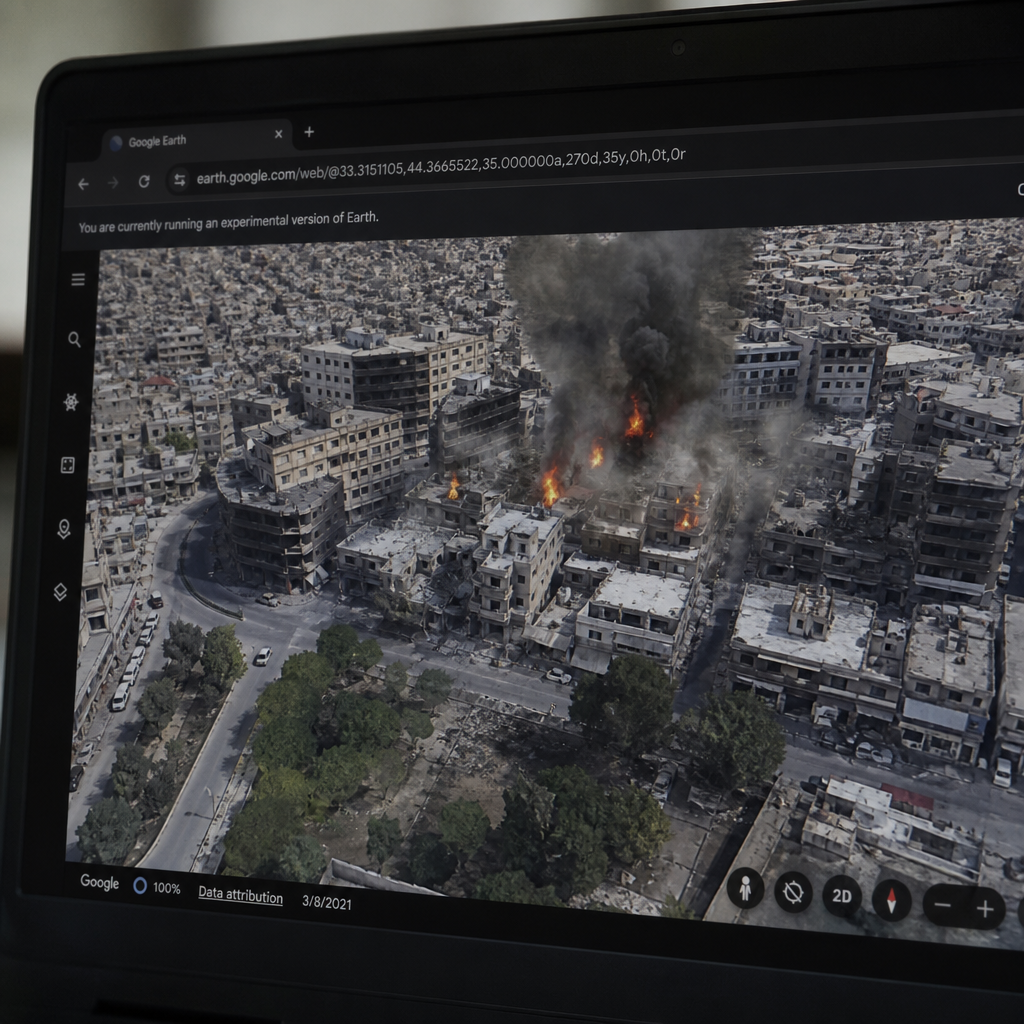
The Digital Reality: How Google Earth Facilitates Fake Scene Creation
In an era where the line between reality and simulation is increasingly blurred, digital tools have become both a boon and a bane. Google’s widely popular mapping service, Google Earth, is at the center of a curious phenomenon that leverages digital landscapes to fabricate fictional realities.
Recently, the use of Google Earth to create fake scenes of bombings, riots, and destruction has caught the attention of many. This article delves into how individuals can manipulate technology to simulate chaos, raising questions about the ethical implications and responsibilities of digital content creation.

Understanding the Tool: Google Earth
Google Earth is a digital globe that allows users to view satellite imagery, maps, terrain, and more. It’s an invaluable resource for educators, researchers, and enthusiasts who seek to explore different parts of the world from the comfort of their screens.
The Power of Digitization
The extent to which digital maps can emulate real-world environments is nothing short of extraordinary. High-resolution images and 3D capabilities offer a detailed and immersive experience that was once unimaginable.
The Dark Side of Innovation
However, these capabilities also empower individuals to create and disseminate misleading content. Fabricated scenes of conflict and chaos can be crafted and circulated, masquerading as real events to suit various agendas.
Creating Fake Scenes: The Process Explained
- Capturing Imagery: Users can capture images from Google Earth to use as a base for their fabrications.
- Editing and Altering: Image editing tools enable the addition of smoke, fire, and destruction, transforming serene landscapes into scenes of havoc.
- Dissemination: Once created, these images can be shared widely on social media, often without verification, contributing to misinformation.
The Consequences and Ethical Dilemmas
While creating digital art or content isn’t inherently harmful, using tools to spread misinformation raises significant ethical concerns. It challenges the integrity of information and can influence public perception and discourse in dangerous ways.
The Challenge of Content Moderation
Platforms like Google and social media networks face the difficult task of moderating content without stifling creativity. Striking this balance is crucial in an age defined by rapid digital information sharing.
Prevention and Awareness: Combating Misinformation
Addressing the issue involves a multi-faceted approach including technological solutions, policy implementation, and public education.
Implementing Technology Safeguards
Efforts are underway to integrate AI-driven detection systems that can identify and flag altered content. Such systems would serve as the first line of defense against misinformation.
Promoting Digital Literacy
Educating the public on identifying fake content and encouraging critical evaluation of digital information are vital measures to reduce the spread of misinformation.
| Aspect | Positive Impact | Negative Impact |
|---|---|---|
| Education | Enhanced learning experiences through realistic simulations. | Potential for spreading misinformation. |
| Research | Empowers research with detailed geographical data. | Can be used to misrepresent data. |
| Art & Creativity | New frontiers for digital creativity. | Can blur the line between art and deception. |
Conclusion: Navigating the Digital Landscape
The dual-use nature of Google Earth exemplifies the broader challenge of digital innovation. As society strives to harness the positive potential of technology, it must remain vigilant against its misuse, ensuring that the world is informed, not misled.